Hammer mills can be used to process:
- cereal crops;
- oilseed meal and meal;
- biomass;
- sawdust;
- spices;
- feed ingredients;
- dry plant material;
- other loose or lumpy materials suitable for impact crushing.
The specific configuration is selected based on the moisture content, density, and size of the input material, as well as the desired output size and production capacity.
How It Works
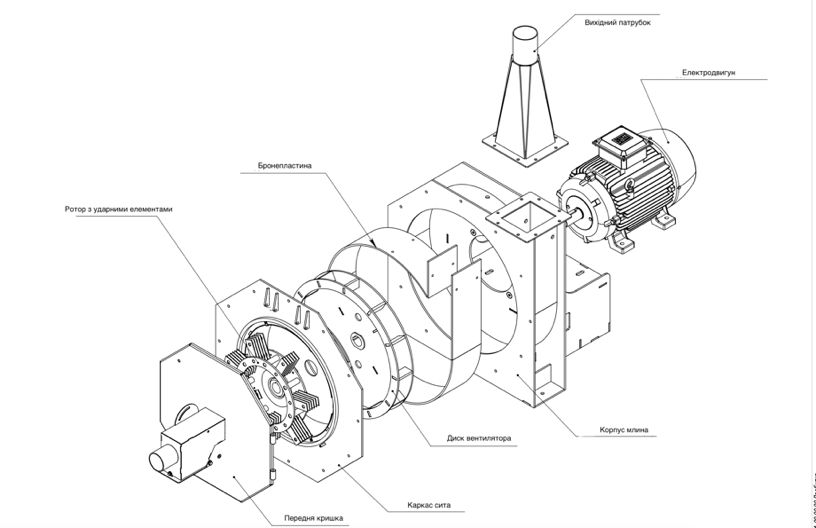
The raw material is fed into the grinding zone, where a rotor equipped with hammers intensively breaks down the material. The final particle size is determined by the screening system, the rotor parameters, the type of hammers, the airflow, and the feed rate.
The pneumatic system performs two functions simultaneously:
- transports the ground product;
- removes heat from the grinding area.
This is especially important for raw materials that may lose quality if overheated or that require a consistent grinding process over an extended period of time.
Power and Performance
The line of industrial pneumatic hammer mills may include models with power ratings ranging from 15 to 45 kW.
Approximate capacity: 1,500 to 5,000 kg/hour, depending on the model, screens, raw material characteristics, and fraction requirements.
Available power options:
- 15 kW;
- 18.5 kW;
- 22 kW;
- 30 kW;
- 37 kW;
- 45 kW.
Actual throughput always depends on the specific raw material. Throughput may vary depending on changes in moisture content, material structure, feed size, or screen aperture diameter.
Faction Control
One of the main advantages of a hammer mill is the ability to adjust the final particle size to meet specific process requirements.
The result is influenced by:
- the size of the sieve openings;
- type and weight of the hammers;
- feed rate of raw materials;
- rotor configuration;
- airflow intensity;
- material properties.
The range of screen aperture sizes can be approximately 0.5 to 20 mm, which allows the equipment to be adapted for various grinding tasks.
Performance Materials
The mills can be manufactured from carbon steel or AISI 304 / AISI 316 stainless steel. The choice of material depends on the application, sanitary requirements, type of raw material, and operating conditions.
For food, pharmaceutical, or other manufacturing industries with strict hygiene requirements, it is generally advisable to consider stainless steel construction. For technical, agricultural, or bioenergy raw materials, carbon steel construction may be sufficient.
Wear Resistance and Industrial Reliability
The equipment is designed for long-term operation in industrial environments. To reduce wear, reinforced components, protective housing plates, wear-resistant hammers, and special surface treatments for the rotor and fan may be used.
This is important when working with abrasive or difficult-to-process materials, where conventional grinders quickly lose their effectiveness.
Equipment Specifications
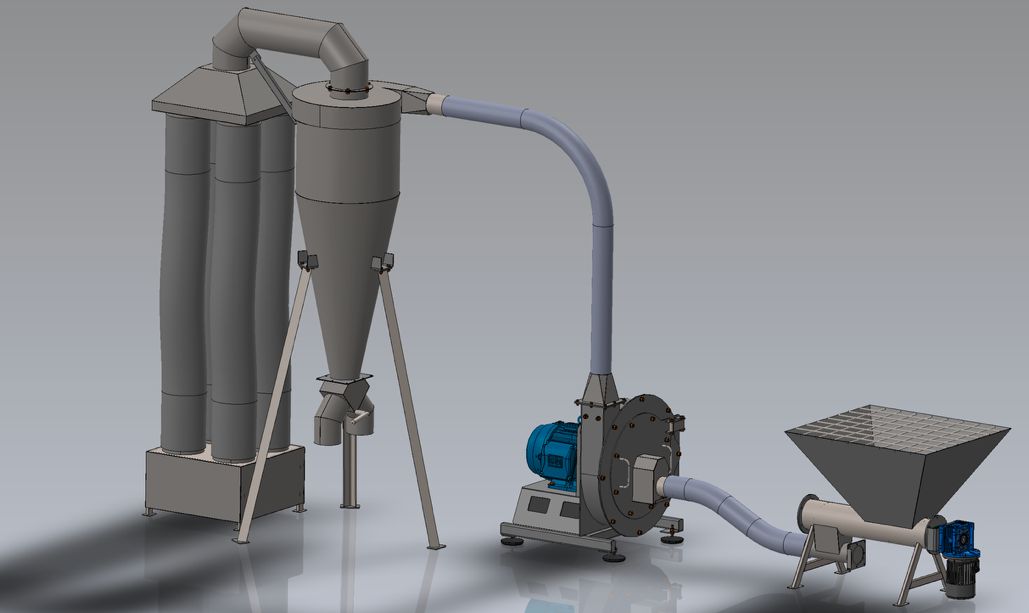
Depending on the project, the kit may include:
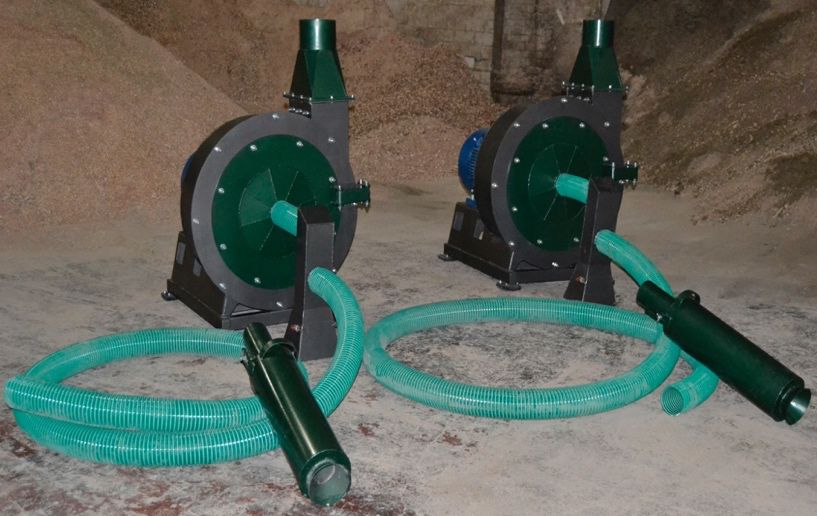
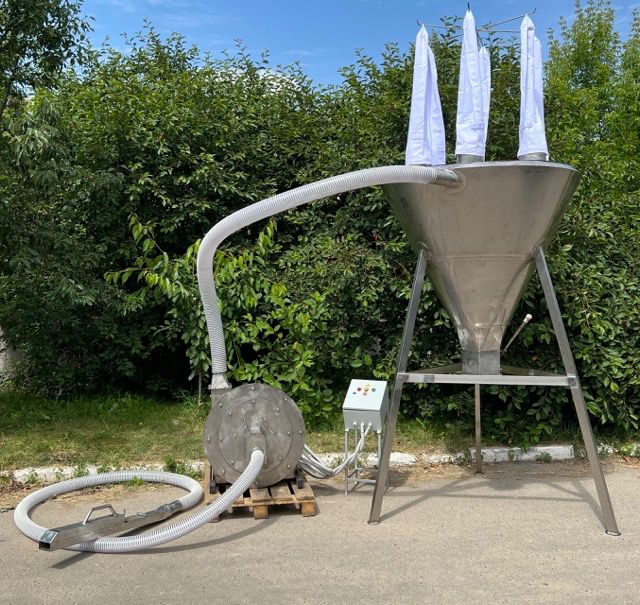
- pneumatic hammer mill;
- raw material collector;
- pneumatic conveying system;
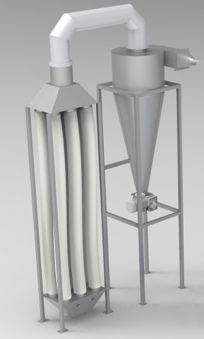
- cyclone or discharge unit;
- hoses for feeding and transporting;
- metal and stone trap;
- control cabinet;
- replaceable screens;
- Additional components for integration into the production line.
The configuration is determined on a case-by-case basis after analyzing the raw materials, the required production capacity, and the equipment installation conditions.
Ekomill Line of Pneumatic Hammer Mills
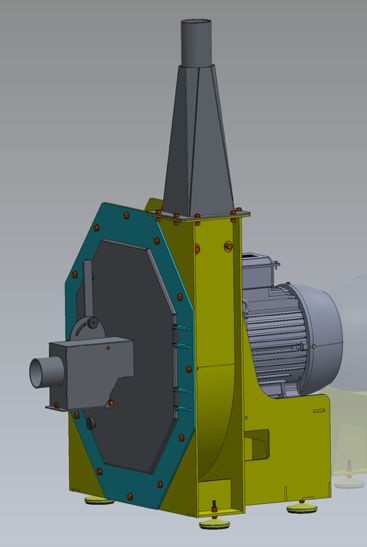
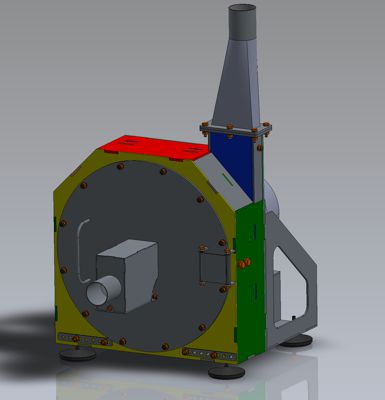
The Ekomill series includes industrial pneumatic hammer mills of various capacities for grinding free-flowing and lumpy raw materials. The model is selected based on the type of material, required throughput, moisture content, feed particle size, and finished product specifications.
The mills can be manufactured from carbon steel, AISI 304 stainless steel, or AISI 316 stainless steel.
Available models
Model / Power
Ekomill-15 / 15 kW
Ekomill-18 / 18.5 kW
Ekomill-22 / 22 kW
Ekomill-30 / 30 kW
Ekomill-37 / 37 kW
Ekomill-45 / 45 kW
Ekomill Technical Specifications
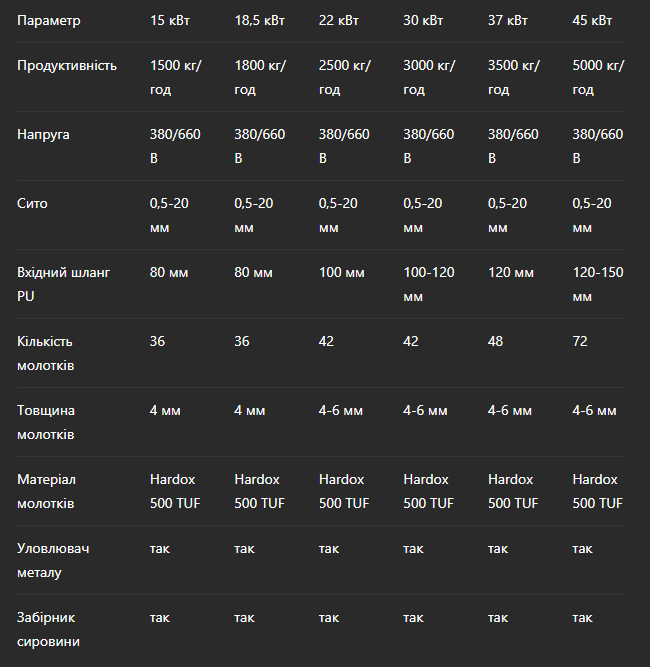
Actual productivity depends on the type of raw material, its moisture content, density, feed size, screen aperture diameter, and feed rate.
Estimated cost of Ekomill mills
Carbon steel version
Power / Price (excluding VAT)
15 kW / 125,000 UAH
18.5 kW / 145,000 UAH
22 kW / 165,000 UAH
30 kW / 198,000 UAH
37 kW / 250,000 UAH
45 kW / 350,000 UAH
Made of AISI 304 stainless steel
Power / Price (excluding VAT)
15 kW / 210,000 UAH
18.5 kW / 240,000 UAH
22 kW / 325,000 UAH
30 kW / 450,000 UAH
37 kW / 520,000 UAH
45 kW / 520,000 UAH
The price may vary depending on the material used, configuration, additional components, automation requirements, and the conditions for integration into the production line.
IP54 Control Cabinet
The control cabinet is selected based on the mill’s power rating and the equipment’s operating requirements.
Mill Power / Control Cabinet Price
15 kW / 35,000 UAH
18.5 kW / 38,000 UAH
22 kW / 45,000 UAH
30 kW / 55,000 UAH
37 kW / 75,000 UAH
45 kW / 95,000 UAH
Additional equipment for the production line
Depending on the application, the mill can be equipped with a hopper, a cyclone, an aspiration system, discharge units, a screen, and other components for integration into the production process.
2,000-liter storage tank
The hopper is equipped with a mixing system and a screw conveyor to ensure a uniform feed of material.
- Power: 4.4 kW
- The cost of the carbon steel version is 150,000 UAH
- Price for the AISI 304 version: 320,000 UAH
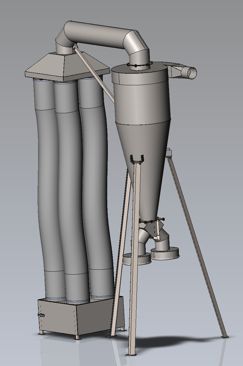
Cyclone unloader with an aspiration column
The package includes a cyclone, an aspiration column, and a rotary feeder.
- Power: 1.5 kW
- The cost of the carbon steel version is 180,000 UAH
- Price for the AISI 304 version: 250,000 UAH
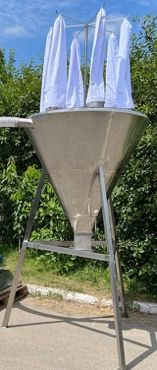
Cyclone unloader with suction stand
The package includes a cyclone, top extraction, a manual valve for two bags, and bag mounts.
- Price for the carbon steel version: 95,000 UAH
- Price for the AISI 304 version: 140,000 UAH
Cyclone Discharger with Manual Gate Valve
The package includes a cyclone, top extraction, a manual butterfly valve, and bag mounts.
- The cost of the carbon steel version is 75,000 UAH
- Price for the AISI 304 version: 120,000 UAH
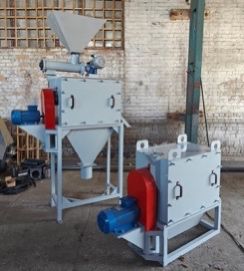
RS-600 Centrifugal Sifter
The RS-600 is a rotary separator designed to separate bulk materials into two fractions after grinding or as a separate step in the production process.
- Capacity: up to 300 kg/hour
- Power: 1.5 kW
- Price for the carbon steel version: 110,000 UAH
- Price for the AISI 304 version: 198,000 UAH
What to Consider When Choosing a Configuration
To ensure that the mill operates consistently at the desired settings, it is important to select not only the motor power but also the entire line configuration. Requirements for screens, hammer types, pneumatic conveying, dust extraction, unloading, and automation may vary depending on the material.
When choosing a configuration, keep the following in mind:
- type of raw material;
- moisture content and density of the material;
- inlet particle size;
- the desired fraction at the outlet;
- planned productivity;
- material specifications;
- method of loading and unloading;
- the need for suction;
- integration with existing production equipment.
UGN Invent Club will help you select the right Ekomill model, construction material, and optional equipment based on your specific raw materials, production capacity, and manufacturing process.
Business Benefits
Industrial pneumatic hammer mills are suitable for companies that prioritize not only productivity but also process stability.
Key benefits:
- high productivity for industrial production;
- controlled fractionation using a sieve system;
- pneumatic conveyance of the finished product;
- reducing the risk of raw materials overheating;
- the ability to work with various types of materials;
- a choice of carbon steel or stainless steel;
- adaptation to specific raw materials;
- the ability to integrate into an existing production line;
- Quick replacement of wear parts.
Who is this solution for?
Hammer mills will be useful for companies operating in the following sectors:
- agricultural processing;
- feed production;
- food industry;
- biomass processing;
- the production of fuel or raw material components;
- grinding spices and dry ingredients;
- Preparing the material before mixing, granulation, or packaging.
Custom selection of a mill tailored to your raw materials
UGN Invent Club helps you select a hammer mill not “based on the model name,” but based on your actual production needs. We take into account the type of raw material, moisture content, feed size, desired output, operating conditions, material requirements, and the potential for future integration into production.
This approach helps avoid situations where equipment is technically suitable in terms of power but fails to deliver the required throughput or grind quality for a specific raw material.
Request a quote for an industrial hammer mill
Do you need equipment for grinding grain, biomass, meal, spices, or other dry raw materials?
Submit a request to UGN Invent Club—we’ll determine the specifications of your material, the required particle size, and the required throughput, and we’ll recommend a mill configuration tailored to your production process.
UGN Invent Club—industrial solutions for crushing, processing, and launching manufacturing projects in Europe.