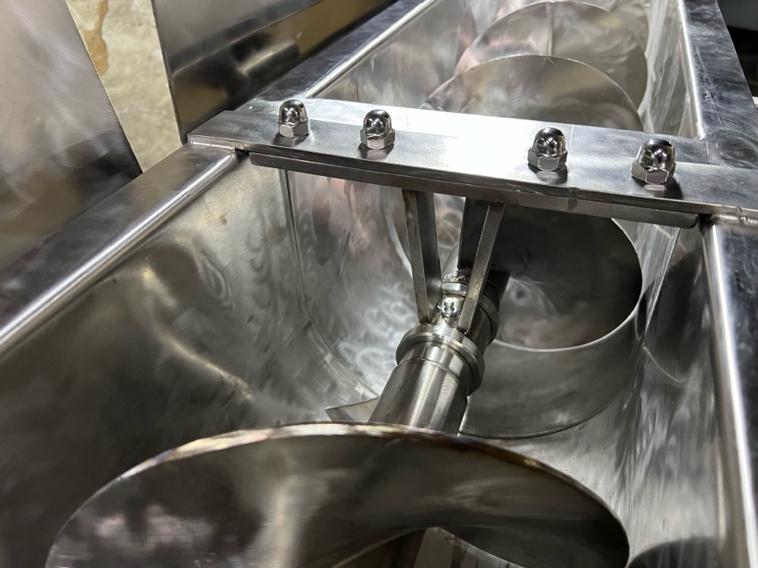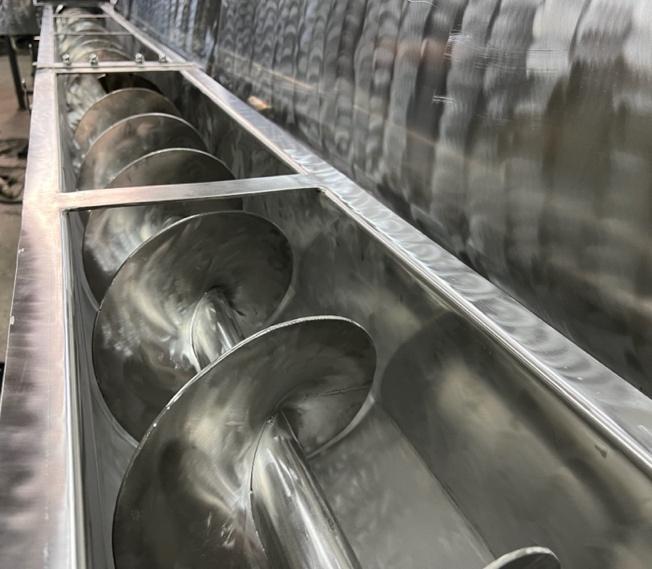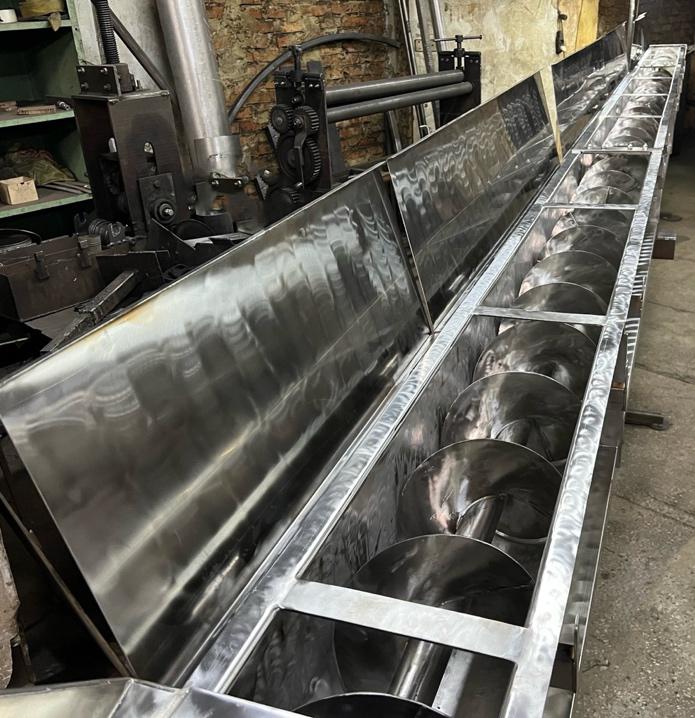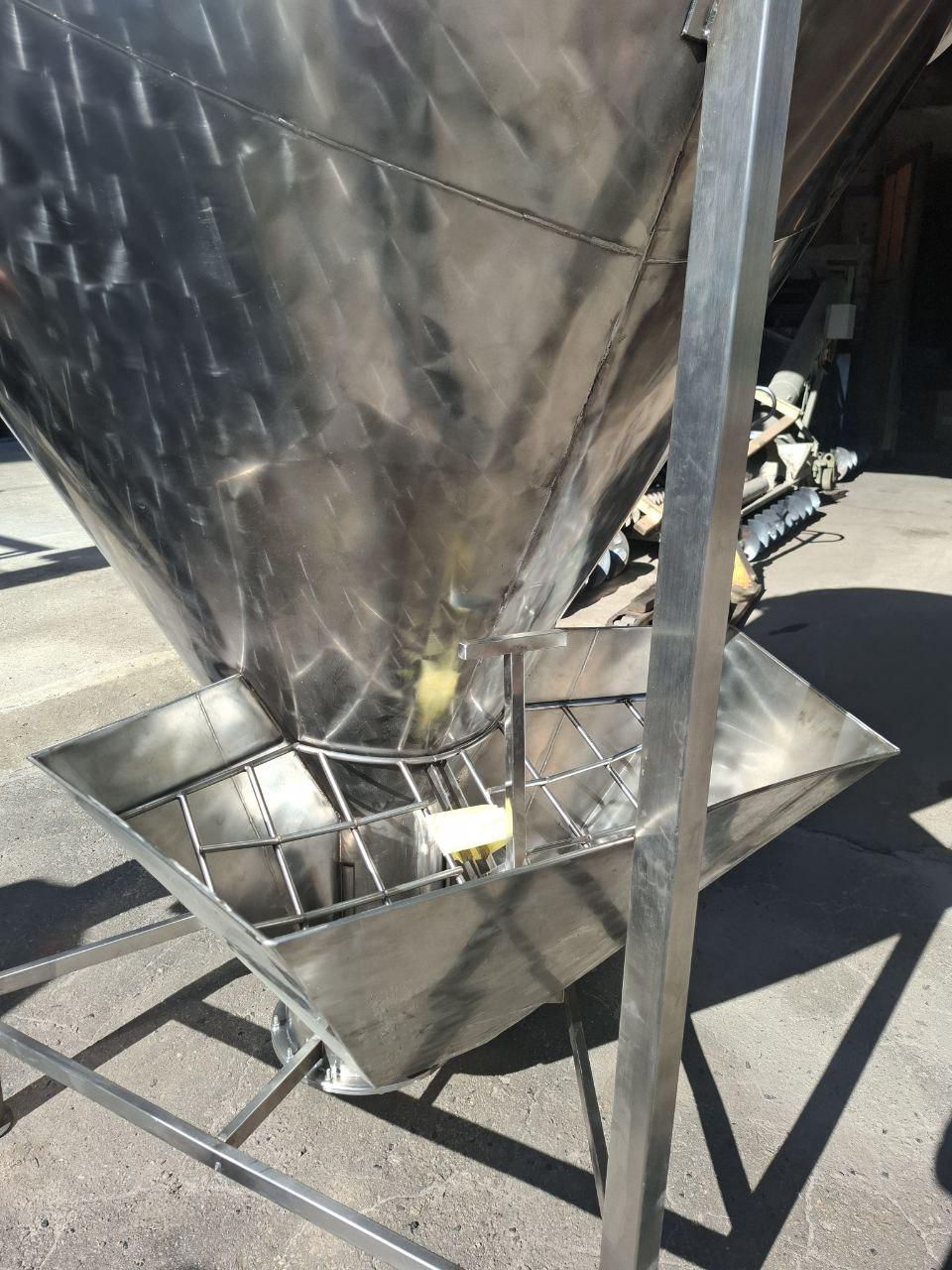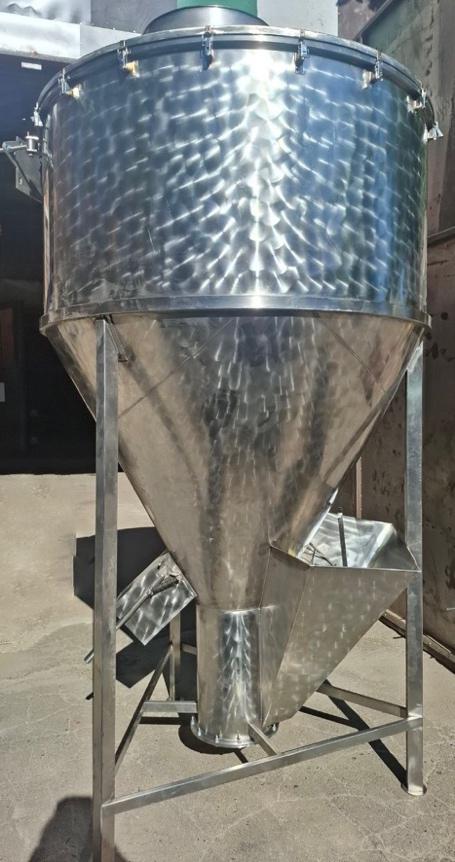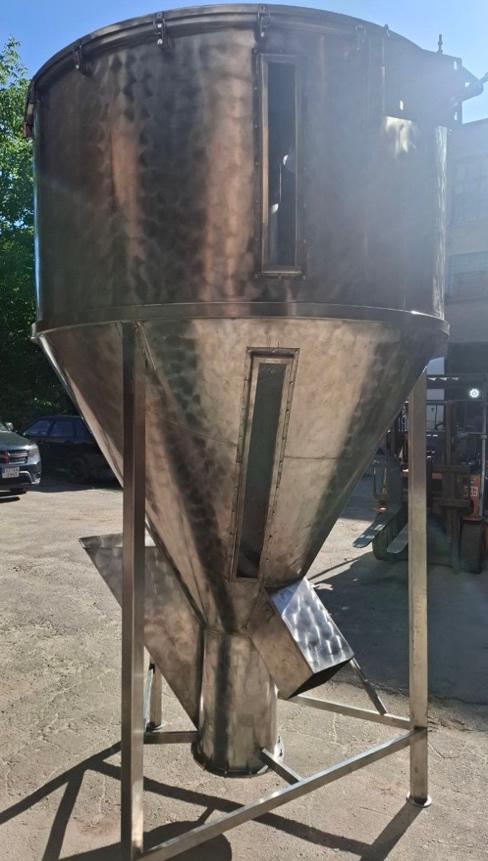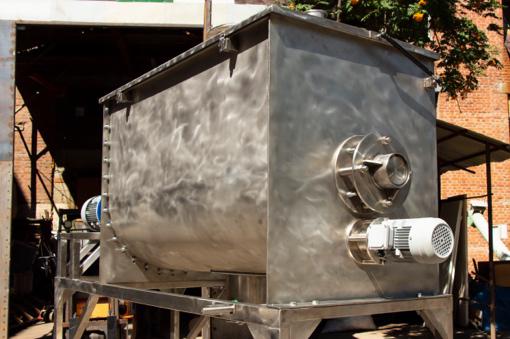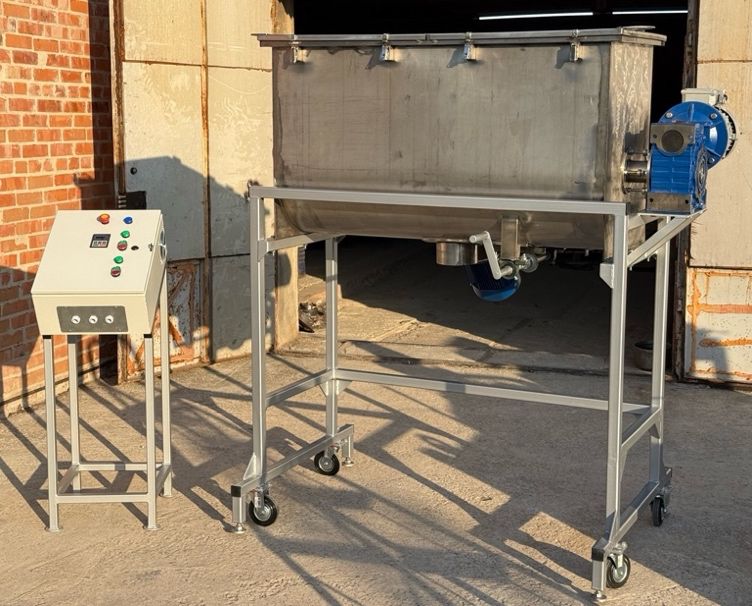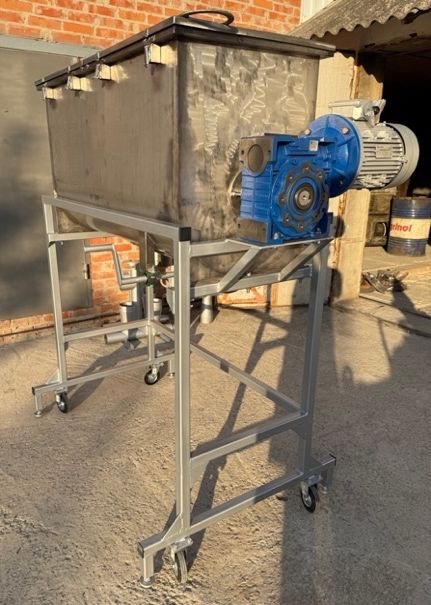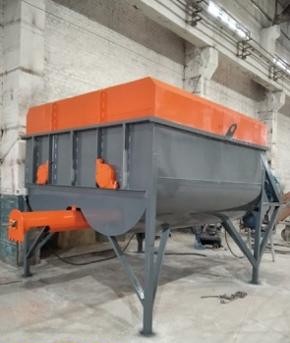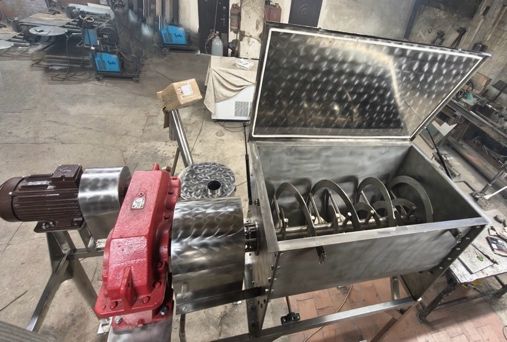
This equipment is suitable for:
- mixing dry, free-flowing ingredients;
- work with powders and granules;
- mixing components of different densities;
- preparation of mixtures prior to packaging;
- the production of food, feed, industrial, or chemical mixtures;
- integration into dosing, grinding, conveying, and packaging lines;
- Operation in cyclic or continuous mode, depending on the project.
The main advantage is uniform mixing without “dead zones”
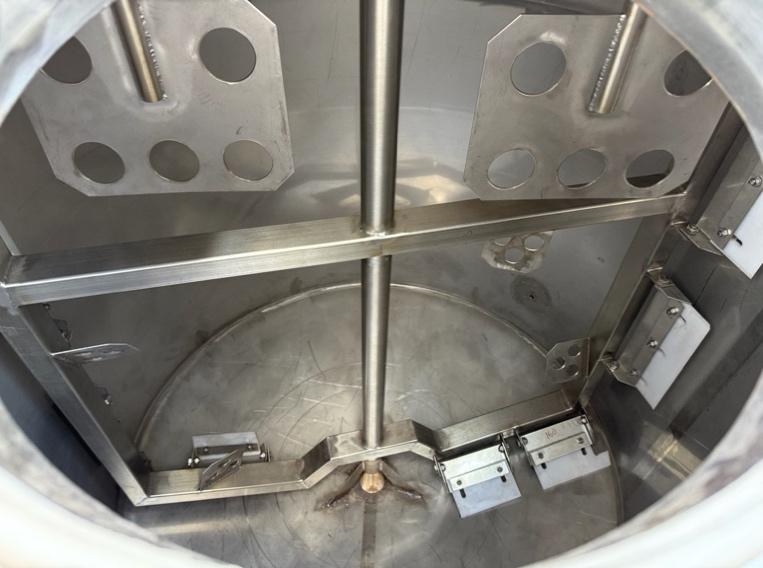
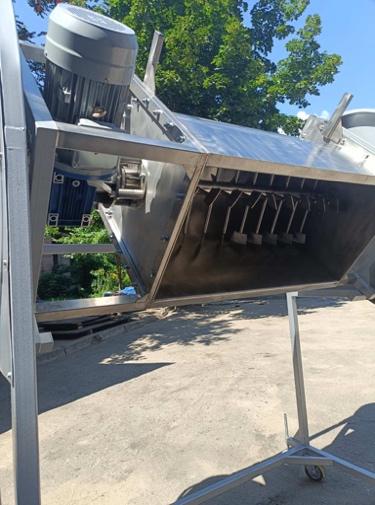
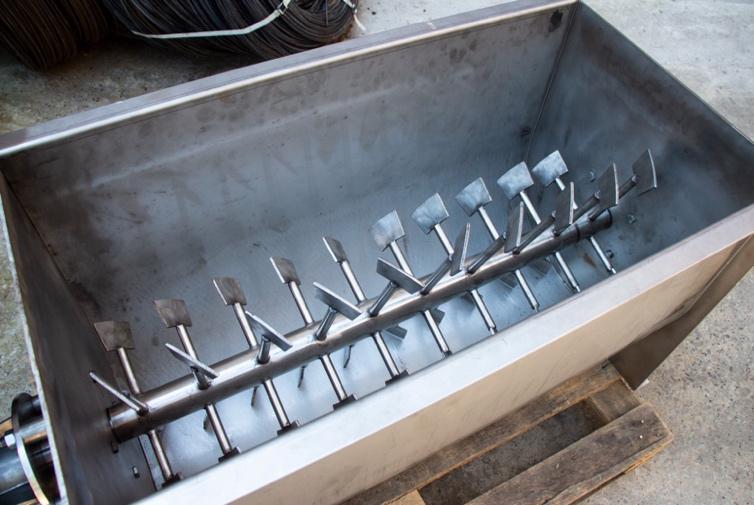
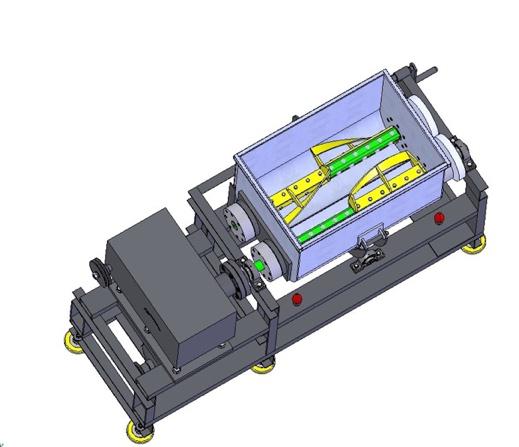
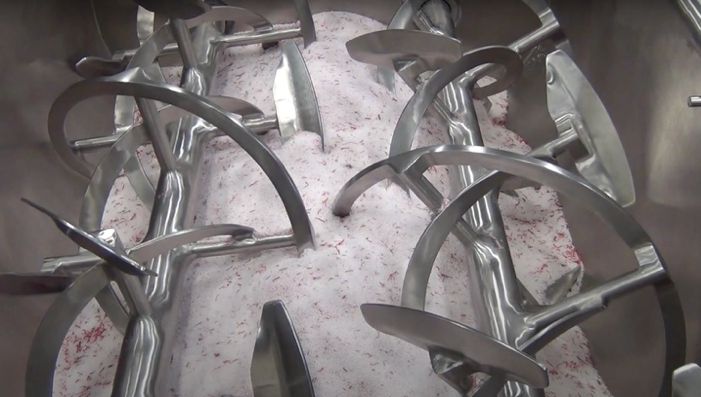
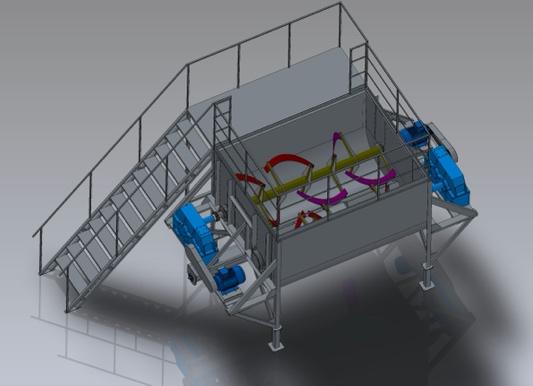
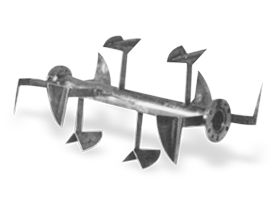
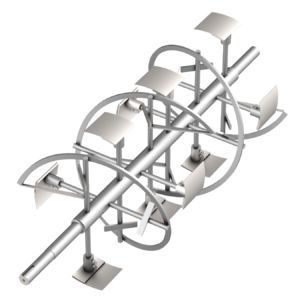
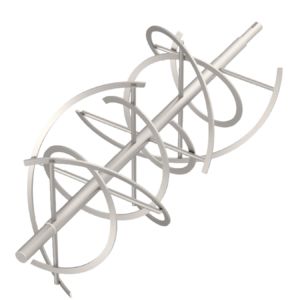
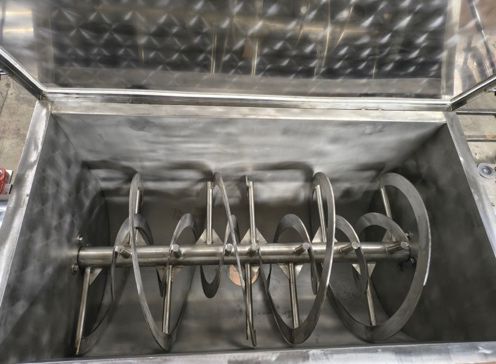
The dual-zone belt system creates a counter-flow of material inside the working chamber. One part of the working mechanism moves the product from the edges toward the center, while the other moves it from the center toward the edges.
Thanks to this principle, the ingredients are actively mixed throughout the entire volume of the mixer, and the risk of dead spots is reduced. This is especially important for formulations where even slight inconsistencies can affect the quality of the finished product.
Volumes and Productivity
Horizontal mixers can be manufactured in a variety of sizes—from compact solutions for small-scale production to large industrial systems.
Approximate range of standard volumes:
- 75 liters;
- 150 liters;
- 250 liters;
- 350 liters;
- 500 liters;
- 800 liters;
- 1,000 liters.
It is also possible to design larger mixers tailored to specific production needs. The choice of capacity depends not only on the desired throughput but also on the fill factor, the density of the raw materials, the mixing time, and the overall workflow of the production line.
Performance Materials
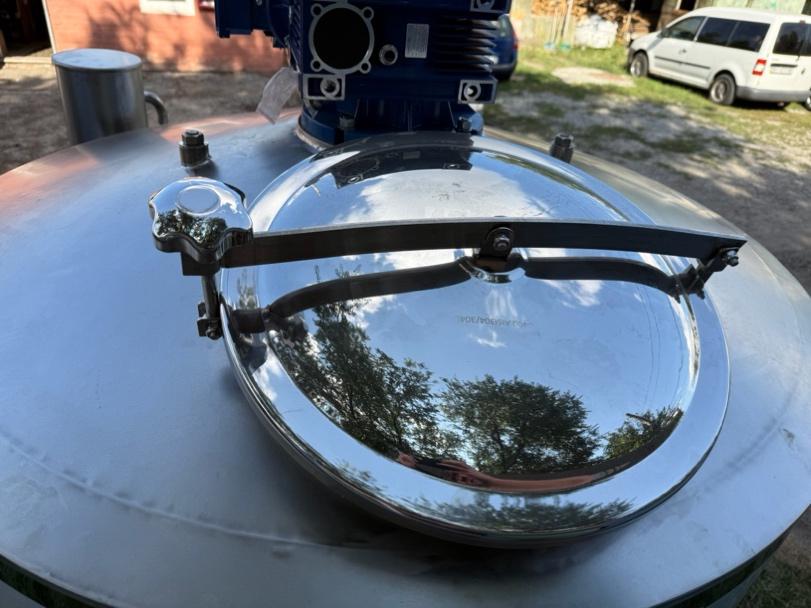
Mixers can be made of AISI 304 or AISI 316 stainless steel, or of painted carbon steel.
The choice of material depends on:
- product type;
- sanitary requirements;
- the aggressiveness of the environment;
- the abrasiveness of the raw materials;
- cleaning conditions;
- fields of application.
For food, cosmetic, pharmaceutical, or other manufacturing industries with strict hygiene requirements, it is advisable to consider stainless steel models. For technical mixtures, carbon steel models may be sufficient.
Types of Structures
Various types of horizontal and vertical mixers can be selected for a specific task:
- ribbon;
- dual-zone belt-type;
- screw-type;
- blade-type;
- twin-shaft;
- plow-shaped;
- vacuum;
- Specialized mixers for non-standard raw materials.
This allows us to go beyond a one-size-fits-all model and select a design that matches the customer’s actual technology.
Configuration Options
The mixer can be equipped with additional components that expand its functionality and simplify its integration into the production process.
Available options:
- high-speed crushers for breaking up clumps;
- a heating or cooling jacket;
- a system for delivering liquid components through nozzles;
- load cells and strain gauges;
- screw, pneumatic, or gravity feeding;
- manual, mechanical, pneumatic, or automatic unloading;
- programmable control system;
- vacuum cleaning and dust removal;
- designed for use in a vacuum;
- wheeled platform with a locking mechanism;
- control cabinet with frequency control and soft start.
Product Line of Horizontal Screw Mixers
UGN Invent Club manufactures horizontal industrial mixers of various capacities for processing free-flowing, powdered, granulated, moist, and paste-like materials. The design is tailored to the product type, density, formulation, required mixing time, loading method, and unloading requirements.
The standard product line includes mixers with capacities ranging from 75 to 1,000 liters. We can also manufacture larger industrial units with capacities of up to 20,000 liters tailored to the customer’s specific process requirements.
Technical Specifications for Standard Models
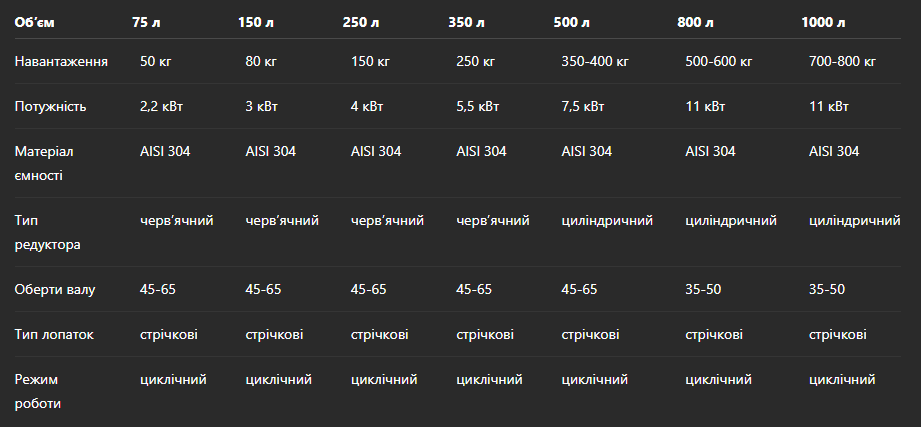
The actual payload depends on the product’s bulk density, moisture content, flowability, formulation, and the permissible filling ratio of the container.
Estimated cost of faucets
Volume / Price (including VAT)
75 L / 96,000 UAH
150 L / 163,000 UAH
250 L / 225,000 UAH
350 L / 296,000 UAH
500 L / 465,000 UAH
800 L / 550,000 UAH
1,000 L / 650,000 UAH
The price may vary depending on the material used, the type of working unit, additional options, the control system, and the loading and unloading automation.
Electrical Equipment and Control Systems
An automatic start function may be available for all models.
Automatic starter for all models – 3,500 UAH.
INVT IP54 Control Cabinet
Mixer capacity / Control cabinet price
75 L / 36,000 UAH
150 L / 39,000 UAH
250 L / 45,000 UAH
350 L / 49,000 UAH
500 L / 65,000 UAH
800 L / 75,000 UAH
1,000 L / 75,000 UAH
The control cabinet can be used to conveniently start and monitor the mixer’s operation, adjust the drive’s frequency, and integrate the equipment into the production line.
Additional Equipment and Options
The mixer can be equipped with components that adapt it to a specific product and manufacturing process.
Option / Estimated price
Wheeled platform with locking mechanism / starting at 24,000 UAH
Belt position adjustment from the chute / starting at 95,000 UAH
Integrated 1 kW AISI 304 deagglomerator / starting at 45,000 UAH
Liquid injection system / customized
Self-cleaning nozzles / customized
Vacuum version / customized
Heating jacket with heating elements / customized
Load cells and electronic scales / customized
It is advisable to consider these options if you need to work with agglomerates, add liquid components, control the exact feed weight, heat or cool the product, reduce dust emissions, or automate the process.
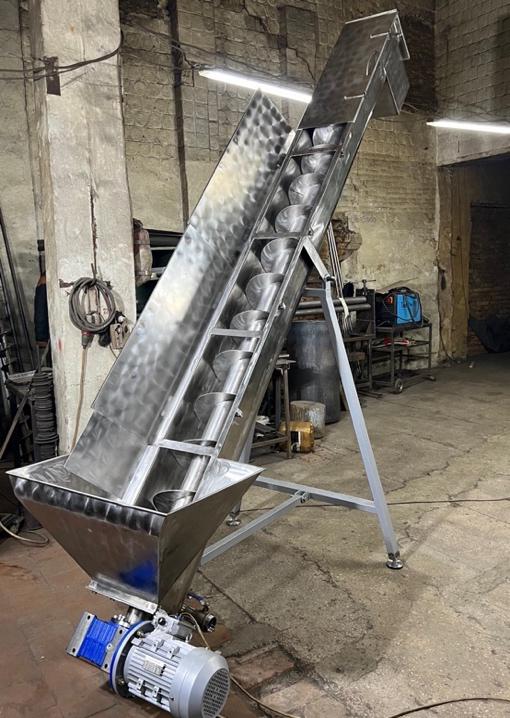
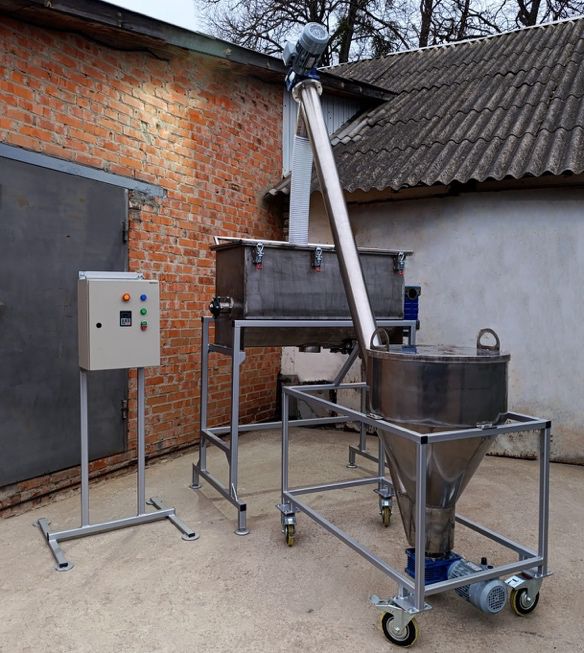
Screw Conveyors for Loading
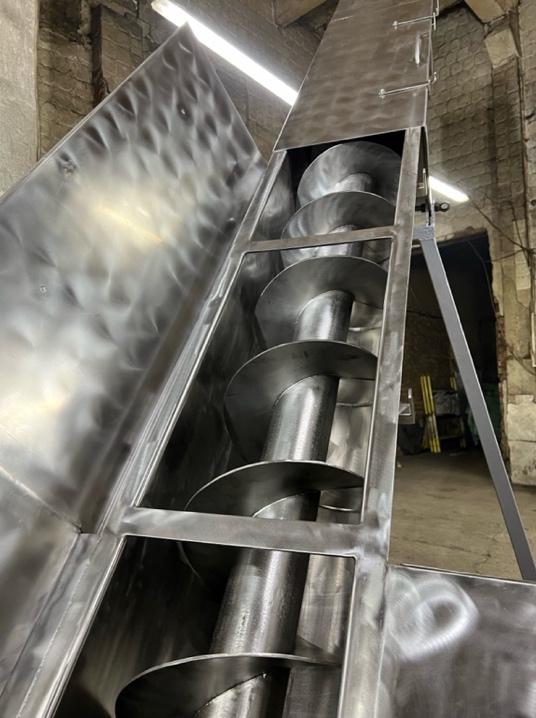
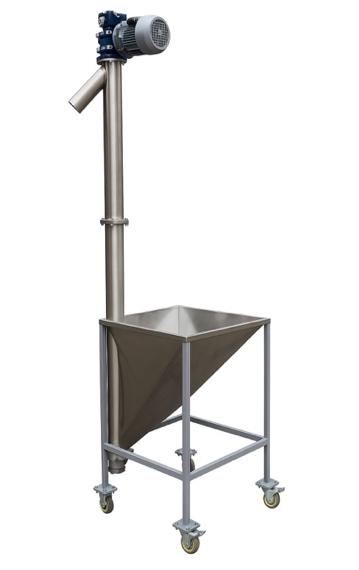
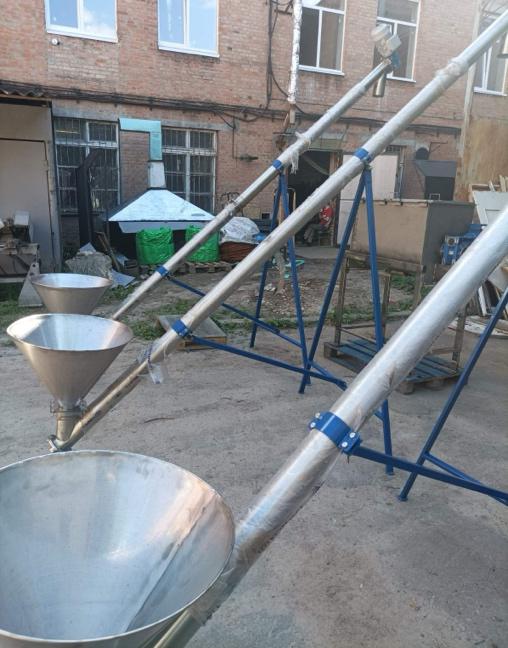
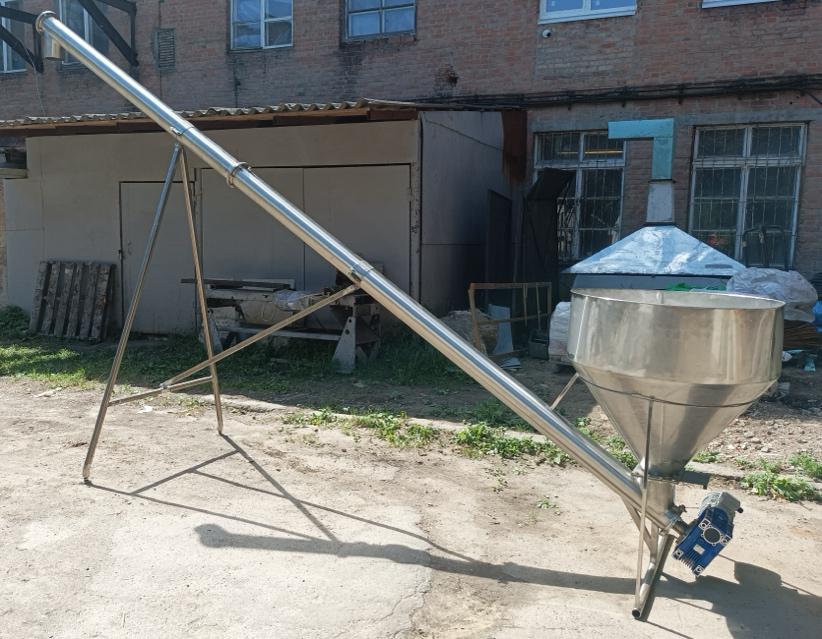
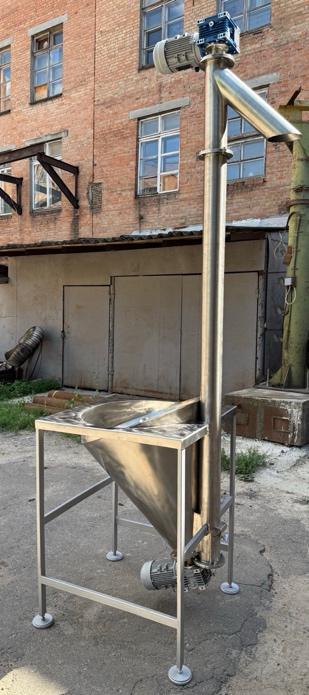
AISI 304 stainless steel screw conveyors can be used to conveniently feed raw materials into the mixer.
Option 1
A screw conveyor with the following specifications:
- diameter – 108 mm;
- length—3–3.5 m;
- material – AISI 304;
- NMVR gearmotor—1.5 kW;
- feed hopper – 150 L;
- wheelbase.
Price: 99,000 UAH, including VAT.
Option 2
Screw conveyor with a raw material agitator:
- diameter – 120 mm;
- length—3–3.5 m;
- material – AISI 304;
- NMVR gearmotor—1.5 kW;
- feed hopper – 150 L;
- raw material agitator – 1 kW;
- wheelbase.
Price: 150,000 UAH, including VAT.
Types of Mixer Working Elements
The type of mixing element is selected based on the product, the recipe, the desired consistency, the mixing time, and the requirements for gentle mixing.
Dual-zone ribbon mixer
Suitable for multi-component mixtures that require a high degree of uniformity. Ensures active agitation of the product throughout the entire volume of the container.
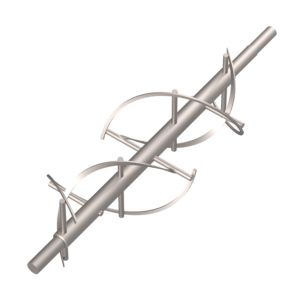
Belt Mixer
A solution for dry bulk materials, powders, and granules. Suitable for applications requiring stable, cyclic mixing.
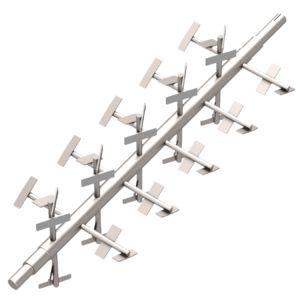
Petal Mixer
It is used for gently mixing dry and liquid ingredients when it is important not to damage the product’s structure.
Petal-and-ribbon mixer
Suitable for products with shortening, soft agglomerates, or components that require both mixing and gentle breaking up of lumps.
Plow-type mixer
Ideal for viscous, oily, or difficult-to-handle products that require intensive mixing and handling of heavier mixtures.
Other Types of Mixers for Industrial Applications
In addition to horizontal screw and belt mixers, UGN Invent Club can design other types of mixing equipment.
Vertical screw mixers
- Capacity: 1,000–20,000 liters.
- Electricity consumption is 2–3 times lower than that of horizontal models.
- The approximate mixing time is 15–30 minutes.
These mixers are suitable for large-scale operations and manufacturing facilities where energy efficiency is a priority.
Twin-shaft paddle mixers
- Mixture homogeneity: up to 99%.
- Mixing time: 1.5–3 minutes.
- Complete unloading with no residue.
Suitable for dry, moist, and paste-like products where cycle speed and minimal residue after unloading are important.
S-shaped faucets
Used for thick and viscous products:
- dough;
- syrups;
- paste;
- thick mixtures;
- muesli;
- protein bars.
Homogenizers for liquids
- Volume: 150–20,000 liters.
- Frequency control.
- Rotor-stator system.
- Speed: up to 3,000 rpm.
They are suitable for the food, pharmaceutical, cosmetics, and chemical industries, where intensive mixing, dispersion, or homogenization of liquid products is required.
How to Choose a Mixer for Your Raw Materials
To select the right mixer, it is important to consider not only the tank’s capacity but also the product’s properties and the logic of the entire production process.
When selecting, you should determine:
- type of raw material;
- bulk density;
- humidity;
- free-flowing;
- the number of ingredients in the recipe;
- the required uniformity of the mixture;
- permissible mixing time;
- loading method;
- unloading method;
- the need for a deagglomerator;
- the need for heating or cooling;
- automation requirements;
- Sanitary requirements for the material used.
UGN Invent Club will help you select the right mixer type, capacity, working element, control system, and additional options for your technology.
Benefits for Manufacturing
An industrial horizontal mixer gives the company control over the quality of the mixture and helps ensure consistency in the production process.
Key benefits:
- mixture homogeneity up to 98%;
- fast mixing cycle;
- operation without reverse;
- less strain on the drive;
- consistent mixing of components with different densities;
- the ability to work with fine-particle and abrasive products;
- adaptation to a specific recipe;
- integration into the production line;
- the ability to automate the process;
- Selecting the appropriate material based on industry requirements.
Where can these mixers be used?
Horizontal mixers are suitable for various types of production:
- food industry;
- production of dry mixes;
- feed production;
- agricultural processing;
- chemical industry;
- cosmetics manufacturing;
- technical powder mixtures;
- the production of granulated or bulk products.
The specific application depends on the composition of the raw materials, the required mixing quality, and the material requirements for the equipment.
A Custom Project Tailored to Your Technology
UGN Invent Club helps you select a mixer not only based on volume, but also on your actual production needs. We take into account the type of raw material, its density, moisture content, flowability, abrasiveness, formulation, required mixing time, loading method, and the subsequent stage of production.
This approach allows us to create a solution that will be easy to use, meet the product’s requirements, and integrate seamlessly into your process flow.
Order an industrial mixer for your project
Do you need equipment for mixing powders, granules, bulk materials, or moist materials?
Submit a request with UGN Invent Club—we’ll clarify the specifications of your raw materials, desired capacity, throughput, and material requirements, and select a mixer configuration tailored to your production needs.
UGN Invent Club—custom industrial solutions for mixing, processing, and scaling up production in Europe.