Industrial Crushing and Powder Grinding Line
UGN Invent Club provides industrial solutions for grain processing and the launch of flour milling operations in European countries. We help select equipment tailored to specific raw materials, target production capacity, flour quality requirements, and the format of the future production facility.
A flour milling complex with a capacity of up to 1,000 kg of grain per hour is the ideal solution for businesses seeking stable wheat flour production, with the flexibility to adjust the milling process, sort fractions, and produce various grades of finished products.
What tasks is a flour milling complex suitable for?
This equipment can be used to set up a fully-fledged mini-plant or to modernize an existing production facility. The complex is suitable for processing soft wheat varieties and can also be adapted to meet the requirements of a specific production process.
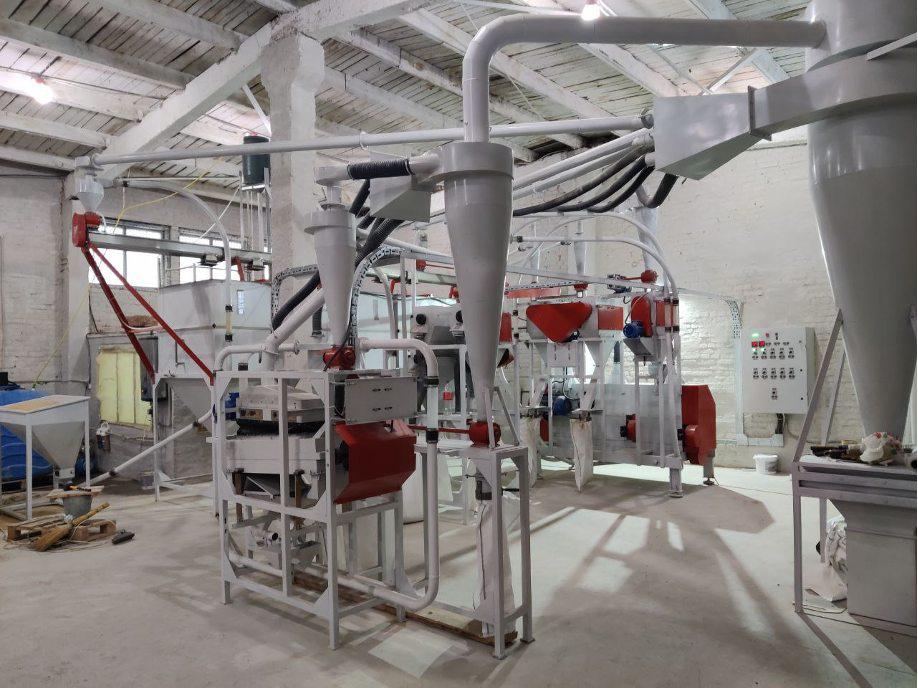
The line can be used for:
- grinding of dry, free-flowing raw materials;
- obtaining a powder or flour-like fraction;
- fractional sorting after grinding;
- re-grinding of the coarse fraction;
- preparing raw materials for subsequent manufacturing processes;
- integration into a production line that includes dosing, conveying, and packaging.
This equipment is suitable for the food, agricultural, processing, chemical, and other industries where consistent grinding of dry materials is required.
The main advantage is controlled particle size distribution
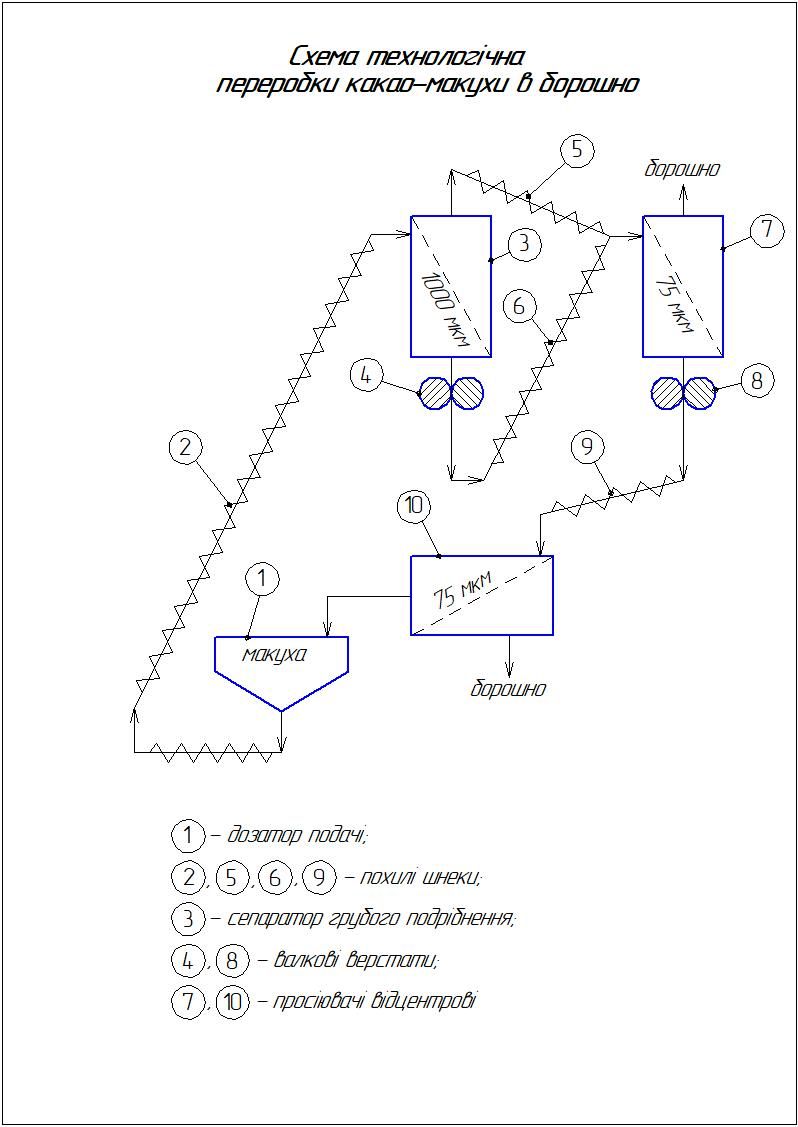
Unlike simple grinding, the line operates as a processing complex: the raw material is fed in measured doses to the grinding unit, after which it passes through a screening system and is separated into fractions.
This allows for more predictable results and enables the equipment to be adjusted for a specific product. If necessary, the coarse fraction can be returned for re-milling, which increases processing efficiency and reduces losses.
How the Equipment Works
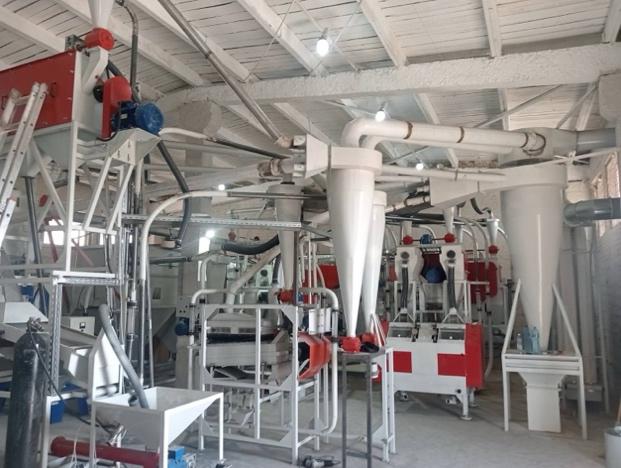
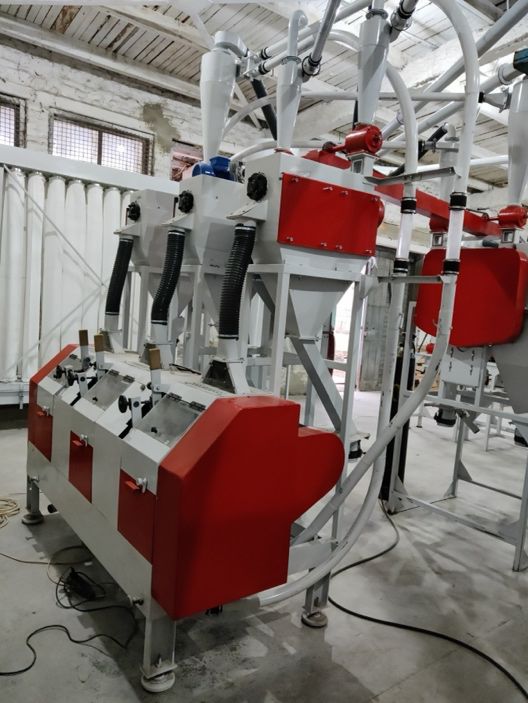
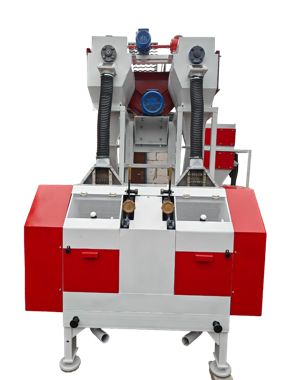
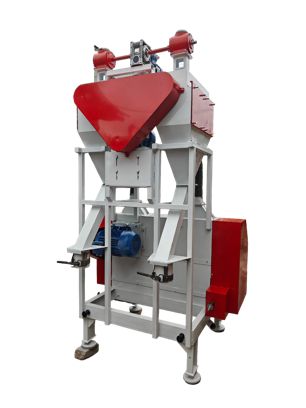
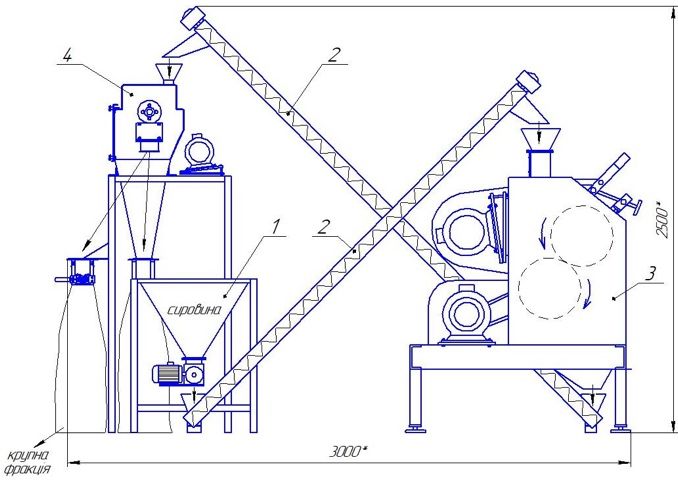
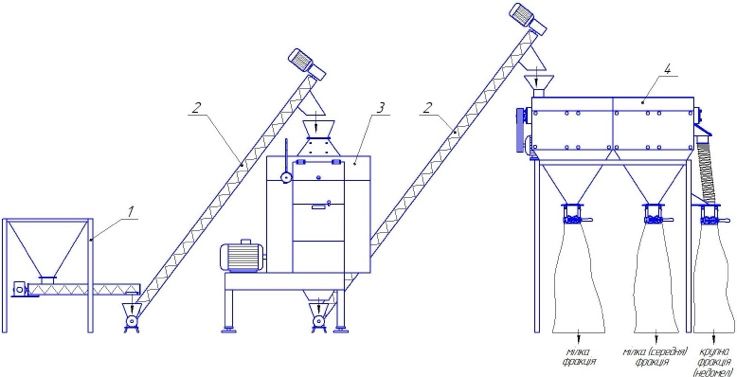
The raw material is fed from the metering hopper at a controlled rate. It is then transported by a screw conveyor to the roller mill, where it is ground.
After grinding, the material enters a centrifugal screen, where it is separated into two or three fractions depending on the screens installed and the process specifications. The finished product can be bagged or conveyed further by a conveyor.
The feed rate and the operation of individual components can be adjusted, making it possible to tailor the process more precisely to specific raw materials.
Estimated performance
The recommended production range for a single line is approximately 300–500 kg/hour. Actual production depends on:
- type of raw material;
- initial fraction;
- humidity;
- fat content;
- the desired particle size;
- line configurations;
- equipment operating mode.
For more complex or higher-throughput tasks, the solution can be scaled by adding additional grinding units.
Technical Capabilities
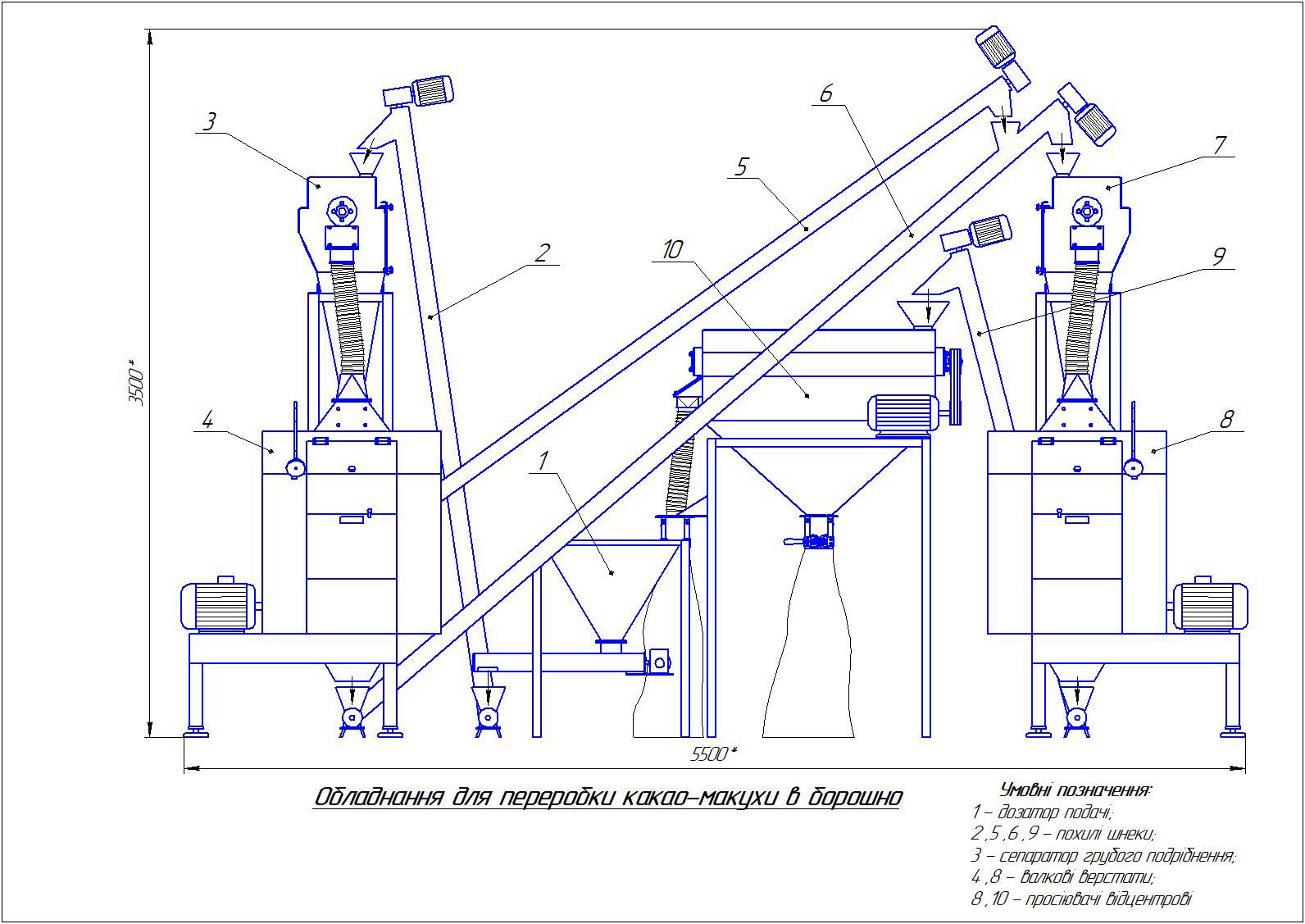
Depending on the configuration, the line may include:
- feed hopper;
- inclined screw conveyors;
- one or two roller assemblies with variable kinematics;
- a centrifugal two- or three-phase sifter;
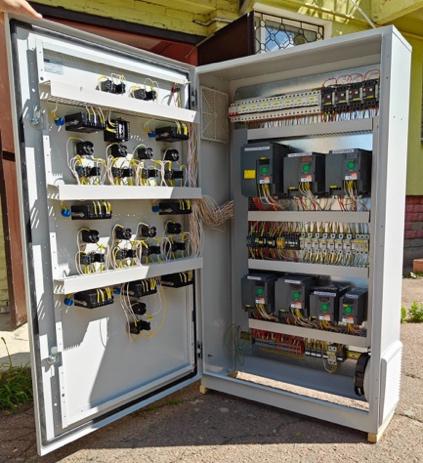
- control cabinet;
- power lines;
- a system for returning the coarse fraction to the secondary mill.
Approximately 25–30 m² of floor space, including a service area, and a room height of about 4 m are required to house the equipment. Specific requirements depend on the configuration, layout, and production logistics.
Technical Specifications for the “Dispersifier” Line
The “Dispersifier” is an industrial line for the controlled crushing, grinding, and sorting of organic and inorganic raw materials. This solution is suitable for manufacturers that need to produce a consistent fine fraction, with the ability to tailor the process to specific materials.
The line produces uniform fractions ranging in size from 40 to 150 micrometers. The exact result depends on the type of raw material, its moisture content, fat content, initial fraction, and the selected equipment configuration.
Key Technical Specifications
- Capacity: 300–500 kg/hour
- Particle size range of the finished product: 40–150 μm
- Recommended fat content of the raw materials: up to 12%
- Recommended moisture content of raw materials: up to 17%
- Required installation area: 25–30 m²
- The required room height is at least 4 m
- Warranty: 18 months
What the complex provides
The “Dispersifier” line is designed for manufacturing facilities where it is not just the grinding process itself that matters, but the consistency of the results. The equipment ensures consistent product quality, minimal heating of raw materials during grinding, low maintenance costs, and the ability to scale up production capacity.
The system can process various types of dry raw materials, and thanks to its quick-change components, it is easier to maintain and adapt to specific production tasks.
Configuration Options
Configuration No. 1—with one VVZK rolling mill
This option is suitable for production facilities that require a compact line with a capacity of 300–500 kg/hour and controlled particle size.
Equipment list:
Equipment / Quantity / Power
Feeder / 1 / 1 kW
Inclined screw conveyor / 3 / 3 kW
VVZK roller mill / 1 / 8,5 kW
Two-/three-fraction centrifugal screen / 1 / 2.2 kW
Control cabinet / 1 / –
Electrical wiring / 1 set / –
Total power: 16.9 kW
Price: 1,260,000 UAH, excluding VAT
Configuration No. 2—with two VVZK rolling mills
This option is suitable for companies that need a more productive configuration with advanced grinding, screening, and regrinding capabilities.
Equipment list:
Equipment / Quantity / Power
Feeder / 1 / 1 kW
Inclined screw conveyor / 4 / 4.5 kW
VVZK roller mill / 2 / 17 kW
Centrifugal two-/three-fraction centrifugal screen / 1 / 2.2 kW
Two-fraction centrifugal screen / 2 / 4.4 kW
Control cabinet / 1 / –
Electrical wiring / 1 set / –
Total power: 29.1 kW
Cost: 2,070,000 UAH, excluding VAT
Advantages of VVZK Roll Forming Technology
The VVZK variable-kinematics roller mill allows for more precise control of the grinding process and the quality of the final product. This is particularly important for raw materials that are sensitive to overheating or require a consistent particle size.
Compared to disintegrators, hammer mills, classifier mills, standard roller presses, and stone mills, the BBMS system offers several practical advantages for production:
- greater uniformity of the finished product;
- lower grinding temperature;
- better control of the fraction;
- lower electricity costs;
- longer service life of working parts;
- the ability to continuously adjust the process.
Terms of Manufacture and Delivery
The production time for the line is 30–40 business days after receipt of the prepayment.
Terms of delivery: EXW, manufacturer’s warehouse.
Payment Terms:
- 70% – prepayment;
- 30% — before shipment.
The warranty on the equipment is 18 months.
To select the optimal line configuration for your raw materials, the desired fraction, production capacity, and production facility, please contact UGN Invent Club for a consultation.
Benefits for Manufacturing
The grinding line gives the company greater control over the quality of the final product and allows it to adapt the process to different materials.
Key benefits:
- adjustable particle size;
- the ability to produce a uniform powder;
- operation without overheating the raw materials;
- fractional sorting after grinding;
- the possibility of re-grinding;
- consistent quality of the finished product;
- energy efficiency;
- adaptation to specific raw materials;
- the ability to integrate into a production line.
Who will find this solution particularly useful?
The grinding line is suitable for companies that manufacture or process products where particle size consistency and reproducible results are important.
This may be relevant for:
- food powder manufacturers;
- enterprises that process grain or plant-based raw materials;
- manufacturers of feed ingredients;
- companies that work with dry mixes;
- processing plants;
- production facilities where raw materials must be prepared before mixing, packaging, or further processing.
Customized line selection tailored to your raw materials
UGN Invent Club helps you select the right equipment configuration for a specific production process. We take into account the type of raw material, its moisture content, fat content, initial fraction, desired particle size, throughput, discharge format, and the possibility of integration into your existing production line.
Important: There is no one-size-fits-all capacity for this type of equipment across all materials. The best results are achieved when the line is designed for a specific raw material and the requirements of the final product.
Request a Crushing Line Design
Are you planning to grind raw materials into a powder or a stable fine fraction?
Submit a request with UGN Invent Club—we’ll clarify the characteristics of your raw materials, your desired throughput, and your fraction requirements, and we’ll recommend the optimal equipment configuration for your production.
UGN Invent Club—custom industrial solutions for grinding, processing, and scaling up production in Europe.